I’m not really sure where I want to take this project yet, but I do know a few things that I’m interested in looking into. Hopefully these will help me decide where I’m going to take my research in the future.
Simon Stalenhag
First of all, I’m hyper-aware of the fact that my illustration practice is pretty character heavy. I do love designing characters and making stories for them, but I’m aware of the fact that I don’t take many risks outside of drawing characters. I don’t often look into environments or exploring complex themes and ideas, which is exactly why I want to do just that. It’s also why I chose Simon Stalenhag to be the first artist I look into.


I found this artist some time ago, but he really inspired me to think more about the environments of my illustrations. His digital illustrations have so much style and atmosphere to them, and they make his work so easily identifiable.
His books also tell amazing stories, but what’s noticeable is that his stories are about the world he created rather than focusing on the stories of characters. I think that is something I would like to look into trying for myself considering how heavily I rely on my character creation.


The first place I want to start is by looking closer at environments and spaces. I want to know how I can give environments a sense of identity. I thought about the idea of world building or exploring inhospitable environments. But overall, I wasn’t really sure about which direction to take my project aside from that I wanted to look into environments.
The Experiments of Calhoun
It started with a closer read into ecology. I thought learning a bit more about the way organisms interact with their environment might give me hints as to the topic I wanted to focus my study on. I’d read some things about the experiments of Calhoun in the past, but one ecology book I found reminded me of him and it got me thinking.


I think that Calhoun’s experiments tell us a lot about our current society and I see a lot of things that happened in Calhoun’s experiments currently happening to us. But getting into the nitty-gritty of sociology is probably a bit too ambitious of a starting point for me, and really there’s only certain aspects of the experiments that pique my interest.

I think I’m fascinated by the set-up of the experiment in general and how it changed as the population of mice continued to grow. Having lived in London nearly all of my life, crowded spaces are common to me and I thought about how I could create these atmospheric, crowded spaces as part of my exploration into environment.
I tried to look into how some artists have interpreted crowded spaces in their work and the way they used perspective. I came across Steve Cutts and his interpretation of the London Underground seemed eerily fitting for the current direction of my research. He represented commuters as a swarm of rats – fitting for my subject of interest – but after taking a moment to think about it his illustration didn’t really appeal to me.

His illustration seemed a little bit cruel to me. Having used the underground all of my life and being one of those rush-hour commuters, I’m not really sure how to interpret this illustration. I wasn’t certain if it was supposed to be a criticism of the deficiencies of the train system or if it was criticising the behaviour of the people using it. Maybe I was reading too closely into it. Either way, I knew that this wasn’t really the direction I wanted to take my research.
The next thing I picked up from Calhoun’s experiment is this idea of observation and privacy. I thought about the effects of overpopulation within the experiments themselves. At the start of the experiment, each rat or mouse had its own den, but as the population grew there was no spaces left for them to sleep. Fights continued on until either death or exhaustion because none of the specimens had a safe space to retreat to, and fights for territory were almost constant.
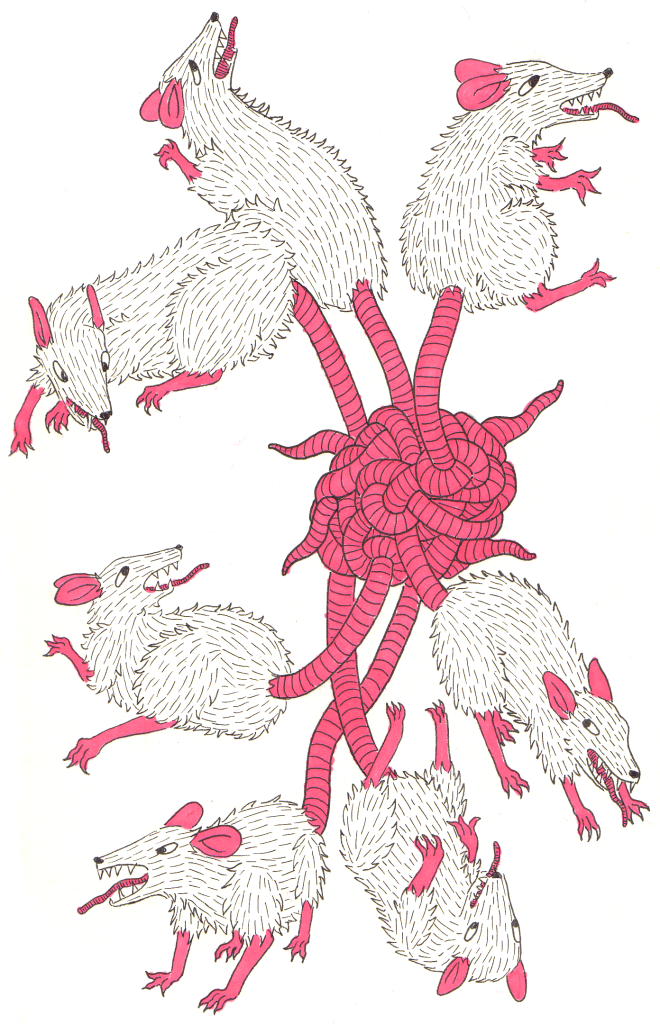
The act of Calhoun coordinating and monitoring the experiments also inspired morbid ideas about power, control, and invasion of other people’s lives. I know what inspired him to start these experiments, but it somewhat disturbed me that he did more than one version of the experiment, and each time he did it he did so on a larger scale. I understand that this was to get some level of accuracy in his results, but the image of him standing over the enclosure and watching this society he had created descend into violence and tragedy brought up a lot of moral questions. It made me think about the thin line between utopia and dystopia.
Henry Darger
The concept of utopia and dystopia is what led me to look into Henry Darger. He s this incredible outsider artist that wrote and illustrated what might be the longest story ever written. He spent almost all of his adult life creating the story of the Vivian sister in complete privacy, using found materials, tracing photographs and pages from colouring books, and telling no one about his creation.
What is especially fascinating about his book The Realms of the Unreal is that the ups and downs of Darger’s mental state can be tracked through the story. The realms of the unreal starts out as a utopia of beautiful, gender ambiguous children that rule their own kingdom. This is probably the happiest the story has been.
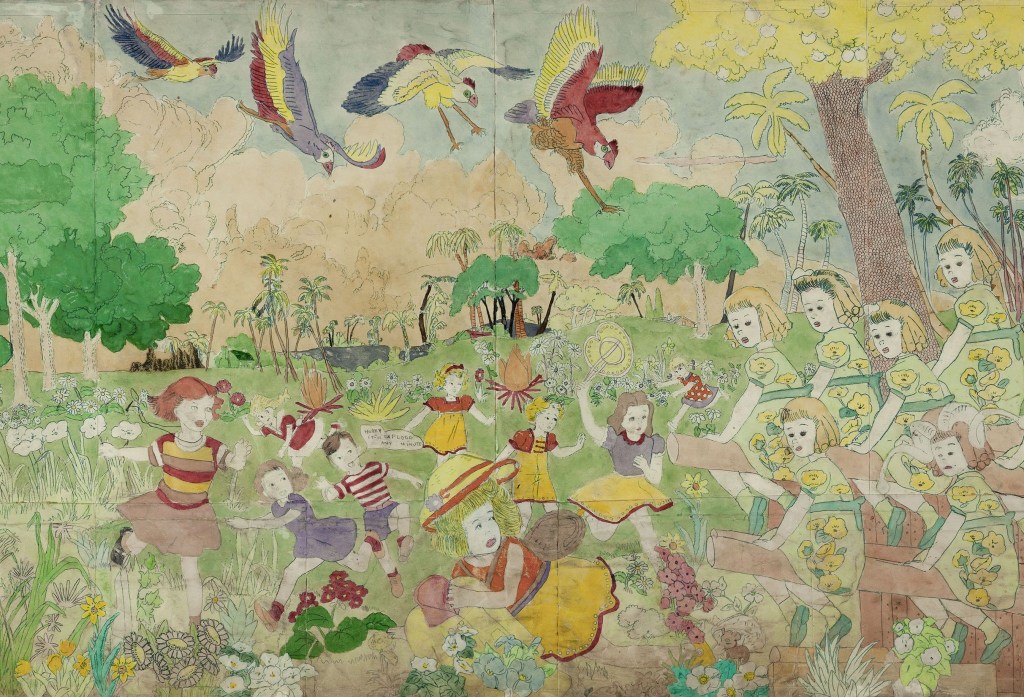
The children, however, are at war with another kingdom, and when Darger’s emotional state later in his life takes a turn and his faith in God is shaken, the story suddenly becomes very different. The Vivian girls begin losing the war. They’re hunted down, betrayed, tortured, and killed. His illustrations become exceptionally dark and gory compared to how bright and innocent they were at the start of his book.
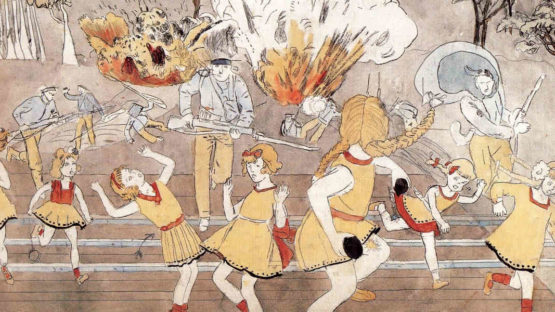
The story from there continues to go back and forth between Heaven and Hell, tragedy and ecstasy, utopia and dystopia. So little is known about Darger himself, and it is only through his stories that we are able to learn about what went on in his private world.
But, I realised after taking a closer look at Darger and watching a documentary about the Realms of the Unreal that it wasn’t really the story that interested me. I was more interested in Darger himself and his life as a misanthrope. It seemed strange that so little was known about him aside from the fact that he lived a generally unremarkable life. It made me want to know more about him – to know about the happenings in his life that shaped his story.
I think, in the end, there are a lot of topics that I’m interested in, but with the help of these sources I’ve narrowed them down to such topics as environments, privacy, and power.
 alicia hempsted