This essay contains interactive images. Please click around to get the full experience of the content.
At the time of beginning my research, my situation naturally compelled me to explore voyeurism. I had temporarily lost my home and was sleeping on the floor of my deceased grandmother’s old flat which was situated in a gated community of apartments. I was surrounded by opportunities to peek unnoticed into the lives of others. Through thin walls and floors, I could hear the private conversations of couples in the surrounding apartments. From the balcony, I could see into the living rooms of the building opposite and watch the occupants play out their evenings in front of the television. Even the apartment itself gave me an intimate look into the life of my grandmother since she had only recently passed, and all of her belongings were almost exactly as she had left them.
Initially, I had only meant to explore what it meant to be a voyeur because I felt like one at the time. But as the definition of voyeur was expanded by my research, I became drawn to a very particular type of voyeurism.
Sitting in on a lecture about Cindy Sherman, I was introduced to the term Scopophilia which led me to read Freud’s On Psychopathology. While scopophilia is typically used to describe the more sexual motivations of a voyeur, the term Schaulust, from which scopophilia was derived, has an etymology that allows for a much broader meaning. Schaulust may typically refer to a general desire to observe or receive pleasure from the act of observation. Cultural historian Tiffany Watt-Smith offers a particularly in-depth explanation in her book On Flinching. She writes,
‘[T]he schau/Schau in Schaulust brings together the activities of watching and being seen, and a Schaulustige may be thought of as someone who wants to look, but who also performs their looking for others to watch’
This interpretation brought to mind a very specific type of spectator culture that is unique to modern society, and that is digital culture. In a digital space, we take pleasure in observing others as well as being observed by others. Social media and streaming platforms in particular commodify this enjoyment that we get from watching other people, and right now these services are booming.
At this moment, all of us are struggling to maintain our lives in reality. Confined to our homes amidst the COVID-19 crisis, it is the lives of our digital selves that are becoming more enriched. We spend more time online finding visual stimulation to supplement a lack of stimulation in our own lives. Our interactions with each other have also been reduced down to a primarily digital scale and our view into the lives of others has become much more intimate as a consequence.
We each have our own reasons for forging digital lives, constructing virtual identities for ourselves, following the lives of other people.


But ultimately, schaulust has become such a deeply ingrained aspect of digital culture that it would be difficult to find someone that doesn’t in some way indulge in some form of digital voyeurism. And yet, despite this, we don’t tend to automatically recognise ourselves as voyeurs when we engage in these activities. The reasons for this were something I was very much interested in discovering as I carried out my study.

Technology’s interaction with art and with us in relation to each other can be complicated. On the one hand, technology is capable of acting as a bridge that brings us together and can make the world more accessible. It gives many people who may not otherwise have access to art the opportunity to view as well as interact with it. Social media allows people to exhibit and share their own artwork as well as educate others on important art history. The benefits of technology’s impact on art is made especially prominent during the COVID-19 crisis, where physical access to art has been practically brought to a halt. Almost every major London art gallery offers some form of virtual tour. The Tate Modern has a 360 video tour following an interview around the Blavatnik Building while The Courtauld, The National Gallery, and The National Portrait Gallery offer static 360 views of almost the entire gallery for viewers to interact with and explore freely.
On the other hand, technology is can represent a barrier that deprives people of a complete experience. When technology interacts with art, it can artificialize it. A painting may be technically a two-dimensional image, but it is also a three-dimensional object with weight and texture. It’s debatable whether a digital image is able to accurately translate the full scale and detail of a piece of traditional art, making it difficult to recognise the image present on a screen as something physical. Most people can recognise Leonardo da Vinci’s Mona Lisa. If one were to see a picture of it online, their immediate thought would be ‘that’s the Mona Lisa’. The reality that we are all aware of and yet don’t always acknowledge is that this image is in fact not the Mona Lisa. It isn’t the image that makes the Mona Lisa what it is, it is the physical painting itself. The same sort of effect can occur when presented with a digital image of a real individual.
With real-world voyeurism, there is typically a relationship between voyeur and subject, which can be something as simple as proximity. In order to observe, film, or photograph someone in real life, you would need to have access to them in real life. The idea is that when you pull away from the image in the lens, there remains some physical evidence of what you observe in the viewfinder. This is relevant even if the person is only a dot on the horizon, or even if the only visible evidence is the building they occupy. As long as there exists something in the lens that you have access to in the real world, there is evidence of its existence. This is something you don’t always get from digital voyeurism.
British Empiricism dictates that existence can be defined by what is able to affect our senses. Sight, touch, taste, and smell all help us define what is and isn’t real. Digital media complicates this process. You might be able to touch the screen, but you can’t touch a digital image. It exists only as code that is translated by your device. You see the image with your own eyes, but only as two dimensional. When you look away from your screen, you cannot place the image into context with the world around you because you don’t have access to the objects in the image. This means that you cannot place the image in what your senses can define as your specific reality.
If you’re looking at digital images of someone who lives on the other side of the world, you would have almost no physical proof of their existence – nothing you could touch, or smell, or experience with your own senses that would indicate that they hold a place in your physical reality. This problem is only exacerbated by editing technology which makes it even more difficult to distinguish what is and is not real in an image.
This is where depersonalisation comes into play.

Early on in my research of voyeurism, I had been examining the depersonalisation that occurs between subject and voyeur in traditional art. After examining the theories of Darwin and Gallup Jr. in The Oxford Companion to Conscious, and revisiting Satre’s play No Exit, I determined that mirrors were a vital tool for apperception of self and helped us place ourselves in context with physical reality. I attempted to explore this by creating a three-dimensional illustration and placing a mirror within it that reflected both the illustrated subject and a literal audience. My intention was to establish a reality in which both the fictional subject and the real voyeur existed mutually within. However, when I tried to capture the experience of my diorama, there was an issue that left me frustrated.
The point of placing a mirror within the illustration was to reflect specifically the face and eyes of the audience, but in my photographs, it was my phone camera that was reflected back at me. All impact of my illustration was lost once it was converted into a digital image, but it did help me realise something. When I took those photographs, there came into existence a new yet different piece of art in addition to the physical art piece. One, the physical object, showed my literal self interacting with an illustrated subject. The other, the digital image, showed my digital self interacting with an illustrated subject. One existed as a physical object, the other as code stored on my phone. In a sense, a barrier was erected between digital and real that I could not overcome.
Psychologist Elena Bezzubova has described a form of depersonalisation that is unique to the digital world. When we inhabit cyberspace, we do so as our cyber-selves and not our real selves, and we speak to a cyber world.

This depersonalisation occurs on many different levels, and for some people it can even transcend the digital space. That is to say, considering the digitally integrated society we currently live in, it isn’t possible to draw a defined line between our digital selves and real selves. Instead, we are given intermittent instances of immersion. Some types of online behaviour can only be properly experienced when one completely disconnects from their physical self and vice versa.
Sometimes, dissociation is necessary. It keeps us sane and helps us maintain our grasp on reality. A fixation on the ambiguity of things that exist in a digital space and unintentionally applying that logic to the real world can develop into a sense of real-world paranoia if left unchecked. It can make people question even seemingly obvious truths about the real world, like the shape of the Earth or even the existence of the moon. Such collectives that do this are typically insistent that any visual material disproving their theories is photoshopped. The advancement of visual editing technology has reached such a point that it may be valid to question almost any image that does not have a physical origin that one can interact with for themselves.
But complete dissociation can also have negative effects. It prevents us from empathising with others in a digital space. Since we do not recognise our digital selves as real, we don’t recognise others’ digital selves as being real. It is by disconnecting one’s real self from they cyber self that we become more willing to engage in activities of digital deviancy. Digital voyeurism would an example of this. One might feel as though they are invading someone’s privacy if they were to explore someone’s phone without their knowledge, but they wouldn’t always feel that same guilt when they’re scrolling through someone’s social media profile. Thus, upon realising this, I came to discover what my intention is in exploring this subject.

In the pursuit of combating the digital depersonalisation that leads one to feel disconnected from the act of voyeurism, I want to explore illustration that is able to transcend that barrier between digital space and reality. Like in my mirror experiment, I seek to establish a plane upon which both physical and digital mutually exist and are able to interact with one another.
While I was looking at different ways of exploring what defines reality and perception, I found that Agostini’s book Visual Games was something that especially inspired me. In the introduction to his book, he writes ‘the perception of objects is not just the result of passive reflection, but a process of active collation, the product of the compilation and processing of data by the brain and the organs of sensory perception’. Ultimately, he is speaking of visual perception and visual language, which in a fast-paced digital world has become the most common and the most effective means of communication. He explains that to fully understand a visual object, we need to open our eyes to perception as an element of psychology and not just accept that things are the way that we see them. Interaction is key to understanding this. To perceive an object is to fully interact with it.
Referring back to the logic of British Empiricism, perception in the physical world requires interaction with the physical senses. But, in a virtual world where we don’t have access to these physical senses, interaction takes on a different form.
Fictional narratives such as alternate reality games, and fictional people in the form of virtual characters thrive on this sense of ambiguity that exists in the digital world. These things exist only in a digital space, but that doesn’t mean that we cannot perceive them or say that they are entirely unreal. This is because we are able to interact with them. Some alternate reality games like The Sun Vanished allow people to interact directly with the characters via social media and even influence the story. Lil Miquela, a fictional CGI model, began as little more than a marketing tool for fashion brands but soon developed into a complete character. She has virtual and real friends and a music career; she’s met and collaborated with celebrities in real life and interacts with her online followers; she makes posts about the goings-on of her life and at one point, this virtual character even had a boyfriend that later resulted in a break-up.
We can interact with these characters and narratives to the best of our ability in a virtual world which means that, to some extent, they are real. They may not be physically real, but they are certainly digitally real. The key, overall, to overcoming the barrier between digital reality and physical reality is finding the right kind of interaction that allows one to fully understand and recognise the other. Real, effective interaction is about more than just clicking a button. It should be about establishing a connection – a relationship – between the digital subject and the real-world viewer in which they are mutually able to affect each other.
Attempting to do something like this with illustration means creating illustrations that be interacted with on both a physical and a digital scale to establish their existence in both worlds.

Creating a physical illustration is not difficult. Provided the illustration has a physical form that can be touched and viewed first-hand, one can establish its existence in a physical reality. In my own illustrations I have even attempted to take physical interactivity a step further by experimenting with three-dimensional sculpture and pop-up illustration. However, establishing an illustrations existence in a digital reality is something more complicated.
Since a digital illustration lacks attributes that one can physically interact with, an alternative needs to be found; something that places one’s existence within the same space as the digital subject. One possibility would be utilising interaction on a more emotional and personal level rather than purely physical. While it may not be possible for the viewer to recognise the physical presence of a subject in a digital image, there are certain means of the digital subject recognising the physical presence of the viewer.
In digital space, people may have a sense of perceived privacy. Anonymity and a lack of physical company may give people the idea that they are somehow invisible to other people online. In John Suler’s articles on photographic psychology (2013), he mentions in his observations of interactions in cyberspace that people on public forums could easily converse as though they were the only two people aware of the conversation, despite the discussion being entirely public. He posited that they felt comfortable doing so because it didn’t seem to them as though other people were present because they weren’t interacting with them. From the opposite perspective, one might feel safe traversing the different digital realms, exploring whatever they desire, because they believe that if they don’t interact in such a way that notifies others of their presence, they can do so undetected.
This is a concept that I had earlier explored in traditional voyeuristic art. That is, making seen what was previously unseen. After examining people’s tendency to romanticise the artwork of Edward Hoppper, I decide to experiment with the idea of giving the hypothetical voyeur of his paintings a noticeable presence in context with the subjects. This idea came about after comparing the positive reactions to his paintings with the negative reactions to Arne Svenson’s photographs in his series The Neighbours.
When I did this, I personally found that some of the more romantic tones of Hopper’s compositions were diluted due to the presence of an onlooker. A hypothetical glimpse into the lives of others was transformed into a more literal invasion of privacy.

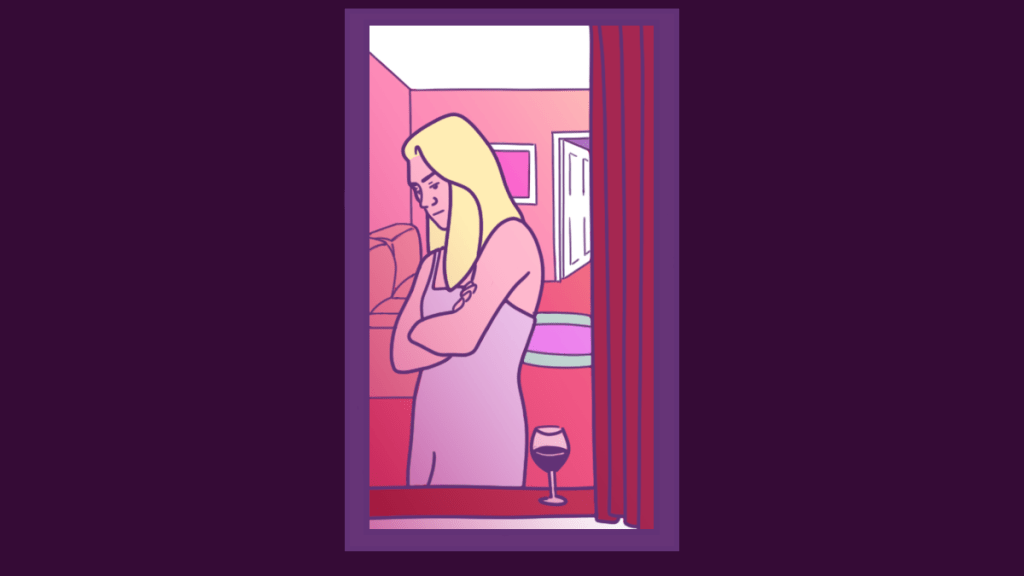


Even if these paintings do not offer a literal representation of a voyeur, a voyeur still exists in the form of the paintings’ audience. However, a physical audience do not identify themselves as voyeurs or feel any sense of responsibility for the act of observation because they feel separated from the two-dimensional image, similar to how one feels separate from what is digital.
In addition, people don’t often think about the way they move about or interact with digital spaces because the types of physical interaction are so minimal. To get from one place to another, it’s as simple as clicking a button…