Something I am somewhat struggling to tackle when it comes to exploring voyeurism is finding ways to humanise the subjects. I feel as though there’s not much point in trying to make a statement if I fall into the same trap as everyone else, which I felt was happening while I was doing figure studies and looking at voyeurism art.
Because of this, I decided to explore some of the negative emotions experienced by the subjects of voyeurism, particularly paranoia. Paranoia is something that I’ve had some personal experience with, so I’m aware of how it feels, but trying to translate those emotions into something visual was a challenge.
Characters
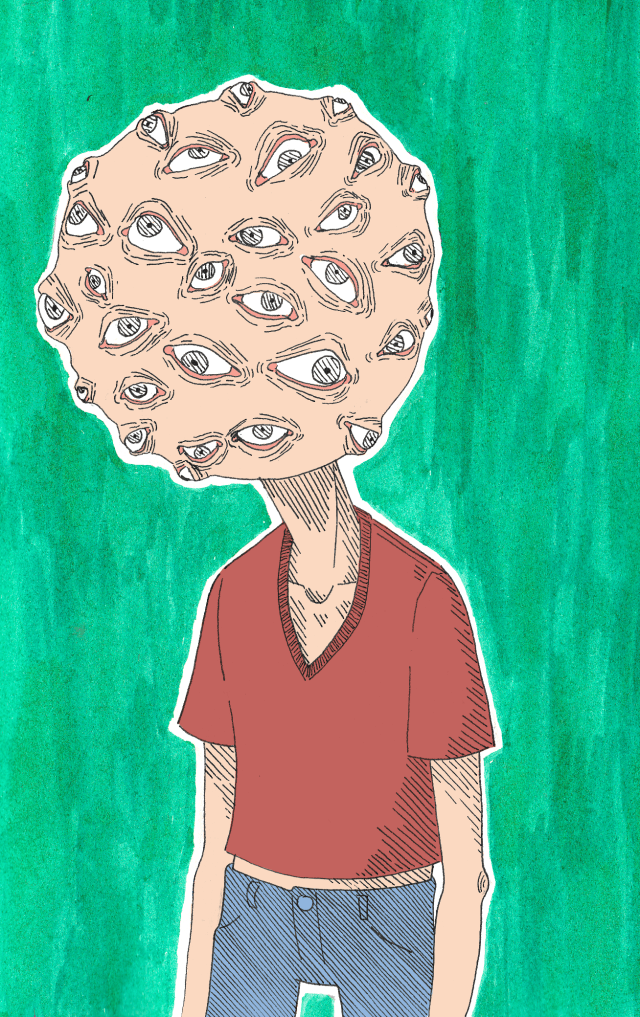
I approached the topic of paranoia by starting from familiar territory, which is character design.
I wanted to design a character that represents paranoia and I came up with what I feel is a simple yet effective concept. His name is Theio. I named him after Theia who is the Greek Titan Goddess of sight. Theio’s head is completely covered in eyes, each one pointing in a different direction, which allows him to see practically everyone around him at all times. He feels compelled to closely watch the people surrounding him because he suspects and fears that they are watching him.
Designing this character helped me work through some of the key concepts of paranoia. Theio represents the antithesis of the concept of Schaulust. He dislikes being watched and so he watches others. Others dislike him watching them and so they watch him in turn. While Schaulust compels people to watch because they enjoy being watched, paranoia compels people to watch because they fear being watched.
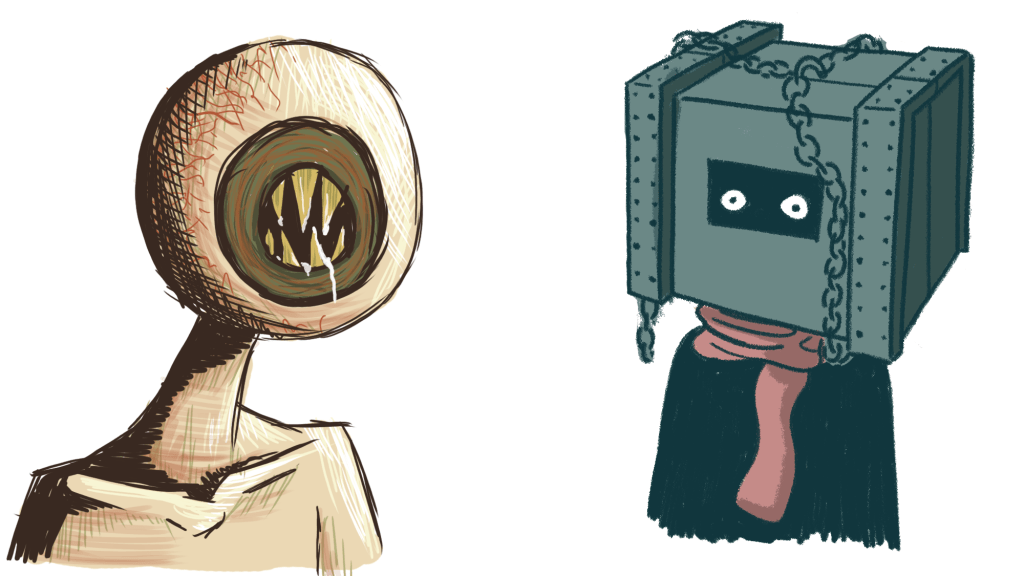
Centre of Attention
Using some of the ideas I explored with Theio, I wanted to create some illstrations that tap into my own experiences with paranoia that people might be able to empathise with.
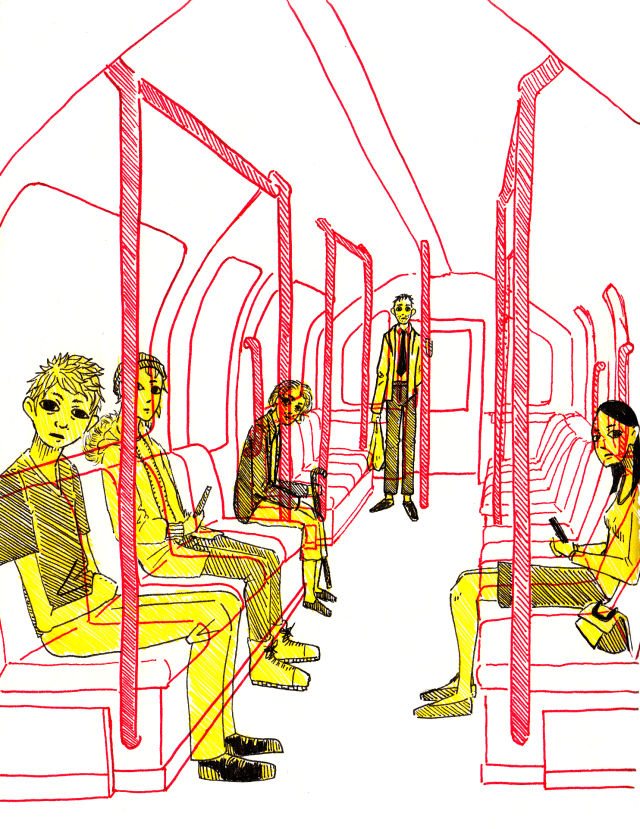
On the London Underground, people do everything possible to avoid eye contact. Everyone has their own reasons for it, but regardless it’s still become a cultural identifier. For me, I tend to avoid eye contact on the tube because it can feel like an uncomfortably intimate thing when you’re in such close proximity to the person.
For people who have the same reasons as me, the concept of an entire train carriage of people looking only at them should make them feel as uncomfortable as it does for me. That’s how I came up with the idea for this quick pen illustration. For a paranoiac, this picture isn’t something they might be afraid of seeing for themselves. For them, this image is something that already occurs when they’re not aware. When you’re looking down at your phone or your book on the train, how certain can you be that the people around aren’t staring at you?
Working in 3D
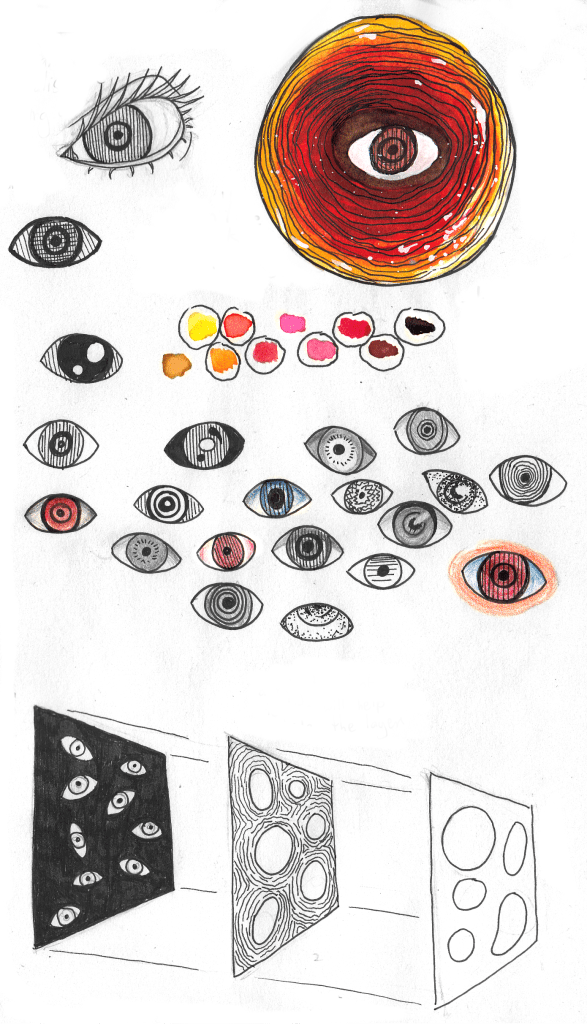
Since I am interested in working in 3D for this project, I felt it important that I experiment with creating a 3D piece to explore paranoia.
When I was thinking of a concept, I was reminded of this viral scary story that’s been circulating the internet for years. The story is about a young boy staying at his grandparents’ house who finds a hole in his bedroom wall. Over time, more and more holes appear around the house and things go missing until it’s discovered that a person had been living in the walls and watching the boy. It’s not a kind of story that one can read very much into, but the visual of holes in the wall with eyes at the end is something that has always stuck with me. Because of that, I decided to make that visual into a 3D illustration.
For my first real experiment with 3D illustration, I wanted to start with something fairly simple. I found my inspiration in a book about creative paper design and came across Stefan Sagmeister’s book Things I Have Learned In My Life So Far. The book itself is just a series of pamphlets and the case for it is a simple box with Sagmeister’s face on the cover. The clever feature of the design is the holes cut through the covering box. Each pamphlet has a different image on one side, so the image shows through the holes cut into Sagmeister’s face on the cover. People can technically change the cover of the book by simply changing which pamphlet is on the top of the pile inside.


I found this idea really interesting and thought of how I might do something similar with my own three dimensional piece. I decided on creating three dimensional ‘holes’ by layering paper and cutting holes through it. At the bottom of each of these holes would be eyes that peer out of the darkness.
I planned to make the holes all different in depth to give the impression that rather than the holes going through the wall, the eyes are actually embedded in the wall. I felt that this would give the piece a more unnerving tone that might tap into elements of trypophobia.
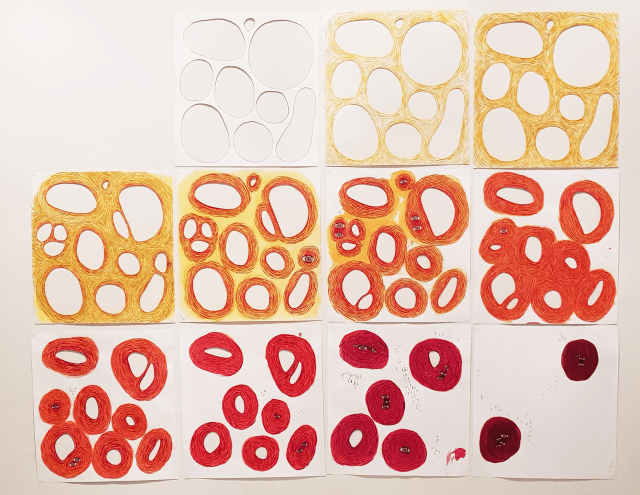
I used watercolour and pen to create this ribbed texture going through all the different layers to disguise the breaks between the different sheets of paper. I decided to paint the holes in a contrasting colour to the top layer because I wanted them to look like more than just holes. I came up with this idea of the holes being made of something alien and unnatural. At first I’d even considered painting the holes in a flesh colour, but found the image a bit too disturbing to follow through with that idea.
When it came to gluing all of the pieces together, I used layers of cardboard to separate the paper and give the image added depth. While this worked well enough for this experiment, the combination of wet glue and the uneven height of the cardboard pieces warped the paper, so if I tried something like this again I would consider an alternative.
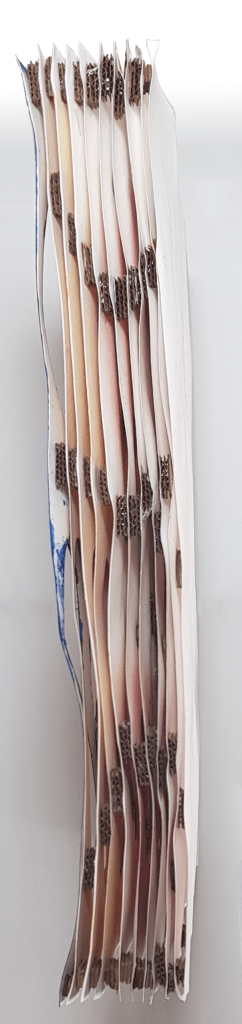
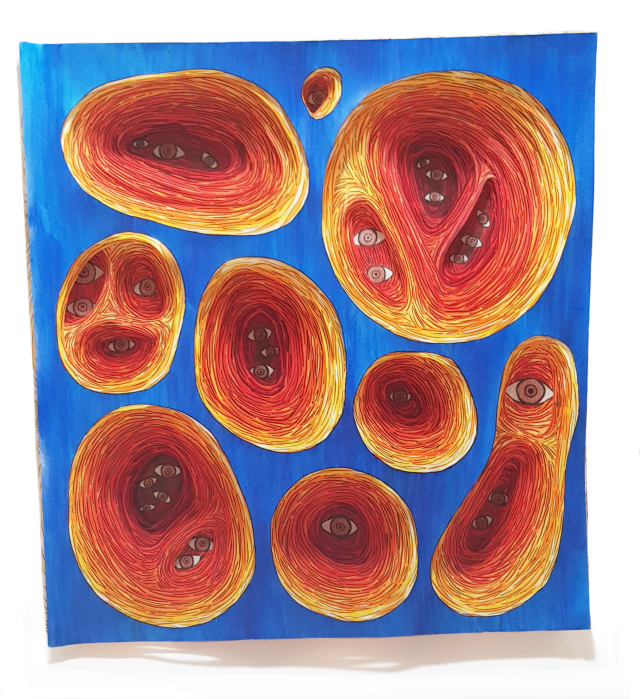
Despite looking a bit unpolished and messy, I’m rather happy with the final piece I ended up with. I did learn a lot from making it that will help me as I experiment more. First of all, this experiment helped me realise how time consuming this process can be. It took me a week to finish despite how simple it looks. Most of my time was spent either drawing lines on the layers or waiting for the glue to dry. Another important lesson this experiment gave me is how important it is to accurately measure the components. I mapped out most of the layers by tracing out the layers of the holes or drawing around already cut holes, and as a result not everything lines up perfectly.
I think the best way to resolve some of the issues of time management and inaccurate measurements is to maybe draw up and paint the layers on the computer and then print them on card for me to cut out. This will ensure I get the most accurate guidelines for me to cut and save a lot of time that was spent painting and drawing each of the different layers.
Overall, this experiment got me excited to work more with 3D and with paper. In future I’m going to look more at paper engineering and find more interesting ways of using paper to create 3D pieces.
 alicia hempsted