I’ve been looking for methods to make my illustrations more interactive with the thought that I might be able to find away to bridge that gap between passive and active voyeurism. I associate passive voyeurism with images and easy information and active voyeurism with a pursuit of some sort of truth. Referring back to the game Little Nightmares, I think it might be worthwhile to experiment with the idea of hiding certain narrative elements within my illustrations that require a bit more effort to uncover. I also got this idea from Nutshell Studies of Unexplained Death. I like the idea of viewers taking on a challenge to discover the truth behind my illustrations.
Visual Games was the first book I picked up to explore this idea, and right off the bat it gave me some really great insight into why visual games can be so compelling. The author mentions that the best way to truly understand an object or an idea is through active reflection rather than passive reflection, which fits so nicely into my exploration of both passive and active voyeurism. I think that in order to overcome denationalisation and humanise the subjects of my illustrations, I need to compel viewers to take an active approach to analysing my illustrations.


Jeff Lee Johnson is an illustrator that immediately came to mind when I thought about how I could hide things in plain sight. At first glance his illustrations like the one below look so sweet and normal, but the closer you look the more disturbing things you find. He rewards people who look closer at his illustrations by giving them the ‘truth’ rather than the beautiful lie that you see on first glance.


Before starting this course, I had tried doing something similar to Jeff Lee Johnson in a piece for one of my personal projects. I designed a large city and within it hid small details that eluded to more sinister things going on. I also included hidden messages in different languages and made references to themes of the project.


I really enjoy adding little details to my illustrations, so this is something that I thought about doing again. The only issue that I have in doing this is that it may require me to provide some sort of narrative or else come up with ideas with lots of hidden details like a Where’s Wally book. So, if I do test this out, I will need to put in a fair amount of work for it.
When I thought about combining the ideas behind the Nutshell Studies and Johnson’s illustrations, I came up with the idea of using invisible ink. It made sense considering the Nutshell Studies are literal crime scenes. I considered using the ink to hide a literal voyeur or maybe change certain elements of a narrative illustration in the same way that Johnson does, showing one perspective in the light and another in the darkness.

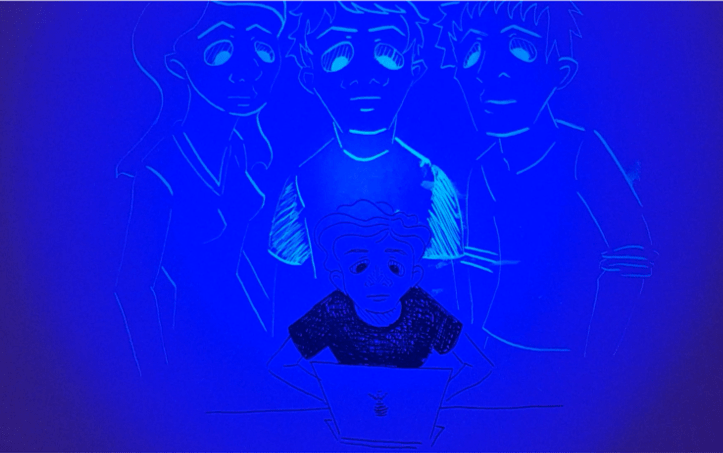

I had a lot of fun using the invisible ink, but in the end I’m not sure that it’s a strong enough medium on its own to continue working with it alone. In order for it to have the impact I want, I think that I need to combine it with something else, otherwise it’s just a novelty. There is the possibility that i could combine it with something like my diorama, but there is the concern that doing so maybe be too close to the Nutshell Studies that it stops being a unique idea. If I do use this ink, I think I should combine lots of different methods of hiding information and use the ink as just one of these methods rather than the only method.

